The studio, flagship
The document desk
One document in, a whole newsroom desk out. Mistral OCR reads it; Mistral Small writes the summary, picks out every fact with the words it came from and puts the summary into Portuguese, French, German and Spanish; Medium 3.5 lays it out as a web page; and Voxtral reads it aloud. Every call goes from your browser to Mistral with your own key, and you see each one before it is sent.
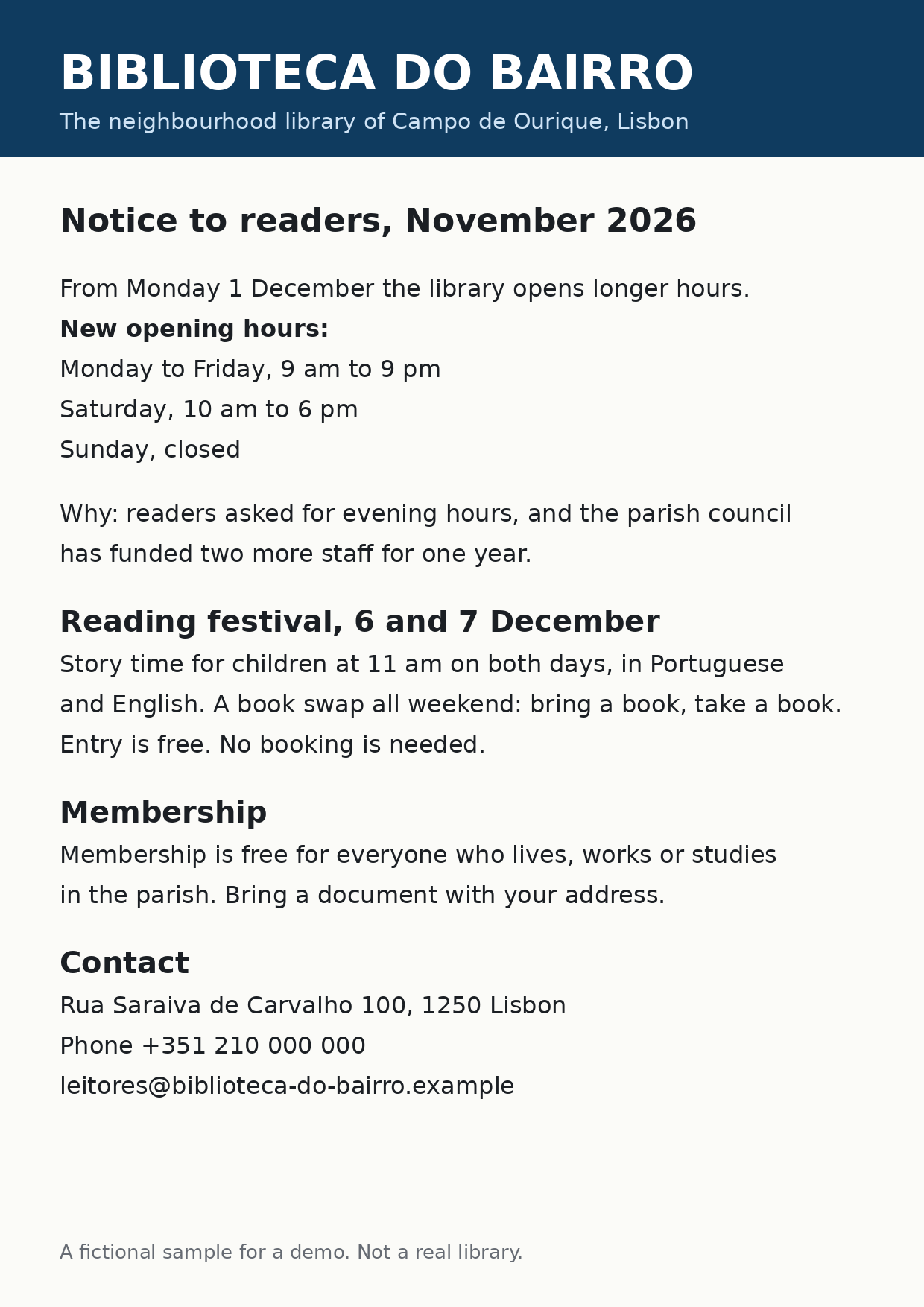
A real run on a fictional library notice, replayed from a file on this site. Nothing is sent.
1. Your document
Document
A notice, a letter, a brochure, a report
PDF, PNG, JPEG or WebP, up to 10 MB. It stays in this tab until you send it, and then goes only to Mistral.
Your document is sent to Mistral (api.mistral.ai or the EU endpoint you chose) to be read. Use only documents you have the right to share: no other people's personal details without their agreement, and nothing confidential. Try the sample instead.
No document chosen yet.
2. Your Mistral key
Your key stays in this tab's memory and goes only to the Mistral endpoint you choose.
If your browser offers to save this key as a password, choose Never.
No key set.
Mistral's Free mode: what you send may be used to train Mistral's models unless you switch that off, so send nothing confidential.
Where your key goes
It goes in the Authorization header, and only when a call is sent. It is never stored, never shown, never sent to this site, and gone when you close or reload the tab. Use a key with a spending limit.
On Mistral's free plan, what you send through the API may be used to train Mistral's models unless you switch that off in your Mistral admin panel (how to opt out, as read on 21 November 2026).
3. The desk
Choose a document (or the sample) and set your key, then start.
What this call sends, and to whom
Nothing yet.
4. Your page
It appears here when the desk is done.
The preview cannot run script or fetch anything: it has sandbox="" and its own content security policy.
What was kept, and why
Each point, fact and section must carry the exact words it came from in your document; this page checks each one, word for word, in code, and leaves out anything it cannot find. The summary and the translations are model output: check them.
| On the page | Value | The words it came from | Found word for word? |
|---|---|---|---|
| Nothing yet. | |||
Every call made from this tab
| Time | To | Model | For | What was sent | Status | Time taken | Usage and cost |
|---|---|---|---|---|---|---|---|
| No calls yet. Nothing has been sent from this tab. | |||||||
Kept in memory in this tab only. Costs are estimates from Mistral's published list prices (pricing, as read on 21 November 2026), times 1.1 on the EU endpoint; models without a published row, and the image tool, say "not computed". Not an invoice.
How it works, and what it does not claim
- The calls, in order:
POST /v1/ocr(mistral-ocr-latest); threePOST /v1/chat/completionswith JSON schemas, for the brief and the facts (mistral-small-2603) and the page (mistral-medium-latest, Mistral Medium 3.5); one more for the four languages (mistral-small-2603); andPOST /v1/audio/speech(voxtral-mini-tts-3) for the audio. All go to the Mistral endpoint you chose, and nowhere else. - The page is built in code from what was checked: the models write no HTML, and its stylesheet is fixed, written for it. Nothing a model writes can run.
- The translations are made from the English summary, by a model; names, dates, addresses and numbers are asked to stay as written, but check them. The Portuguese is asked for as European Portuguese.
- The recorded run used a fictional library notice, drawn in code; Biblioteca do Bairro is not a real library. The run is in recorded.json, as the models answered, including a spelling slip in the summary ("Campo de Ourque"), which is why the summary is marked as model output.